
Scaling
Your business may be growing. Why is it becoming harder to run?
Growth creates demands. Sustainable scale depends on whether the organisation can carry them.
What does it mean to scale a business?
Scaling a business means increasing the volume or complexity of work it can handle while maintaining delivery, margins and the speed of routine decisions. For founders and boards, the practical test is whether the team can keep customer commitments as demand rises without depending on the same people to step in repeatedly.
Growth is not scale
More activity can create more fragility.
A rising turnover line can hide stretched margins, weak management systems, growing decision queues and an organisation that still relies too heavily on its founder.
The question is whether capability is growing alongside demand, not simply whether the business is getting bigger.
Where to look
What the next stage may demand.
- Decisions that are clear enough to be made without continuous founder intervention.
- People with appropriate ability, skill and authority for the work.
- Systems that make dependable work easier rather than more bureaucratic.
- Leadership capacity that grows as the organisation becomes more complex.
- Measures that distinguish profitable progress from activity and scale for its own sake.
From the bookshelf
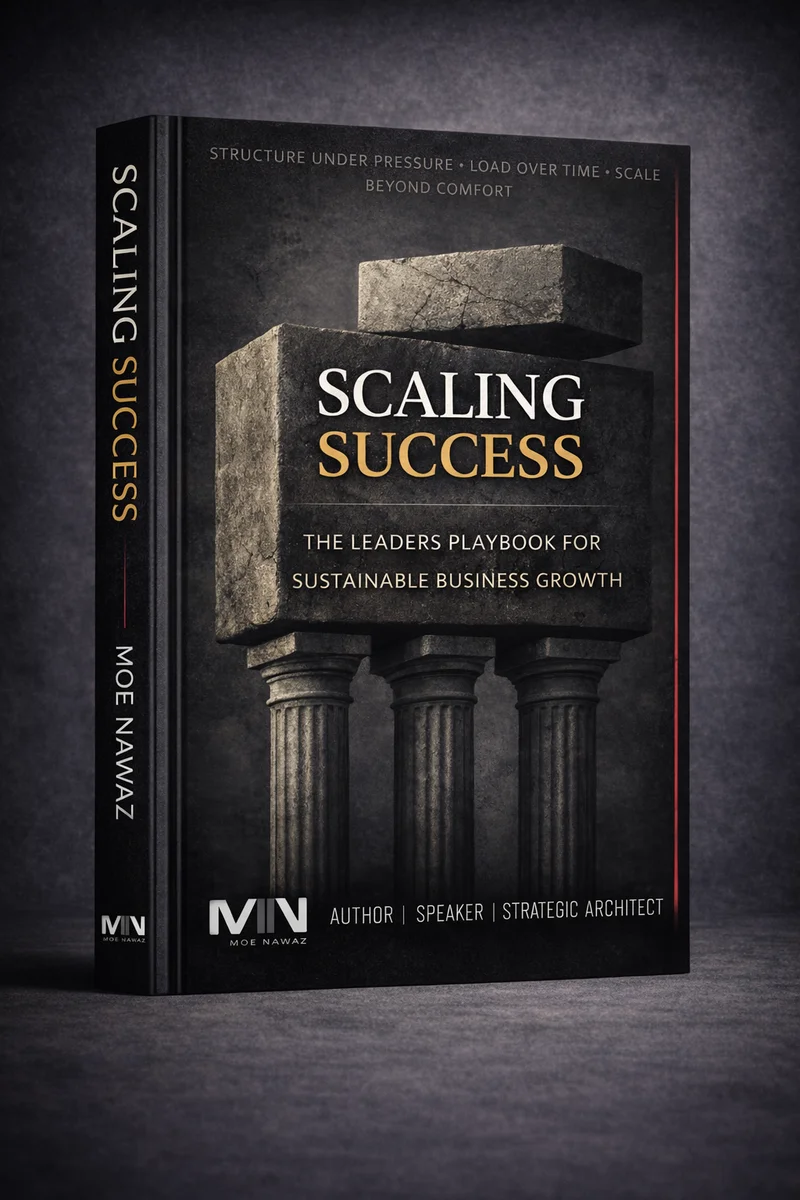
Scaling Success
The book explores why successful organisations can accumulate strain beneath the surface. It invites leaders to look beyond growth statistics and examine what the organisation is becoming.
Vision and scaling
What must we become?
The first 3V question asks where the organisation intends to be. Its companion question asks what it must become. That may mean changes in decision-making, leadership, capability and economics long before the destination is reached.
Questions and answers
How can I tell whether we’re ready to scale?
Compare recent jobs at different levels of demand. Track how many started and finished, how long customers waited and how often someone had to intervene. See how a growing backlog exposes pressure.
Will hiring more people remove the bottleneck?
It can if the bottleneck is a sustained shortage of capacity in specific work. If jobs are waiting for information or approval, trace that delay before adding people to the queue.
What should the board measure as the business grows?
Review delivery reliability, margins, time to complete work and the number of exceptions senior leaders handle. Read the figures together so you can see where an improvement in one team is shifting cost or delays elsewhere.
How can we reduce founder dependency before an exit?
Choose a decision that still comes back to the founder and test whether another leader can make it within agreed limits. Read how to test an ownership handover.
A private conversation
Is your business getting bigger, or becoming stronger?
If your organisation faces a meaningful challenge, we can start with a conversation.