
Insights
Why Profitable Businesses Still Fail
A profitable business can still fail when cash arrives too late, when a few people are doing work the organisation depends on without anyone seeing it, or when the business keeps making commitments it no longer has the capacity to keep. The profit may be real. The harder question is whether the conditions that produced it will hold through another busy quarter.
When someone shows me a good month, I want to look at two or three jobs that helped make it good. Who made the promises? What did it take to keep them? When did the money come in? Those are straightforward questions. The answers can give a board a very different view of the same results.
Profit tells you what you earned. Cash tells you what you can pay.
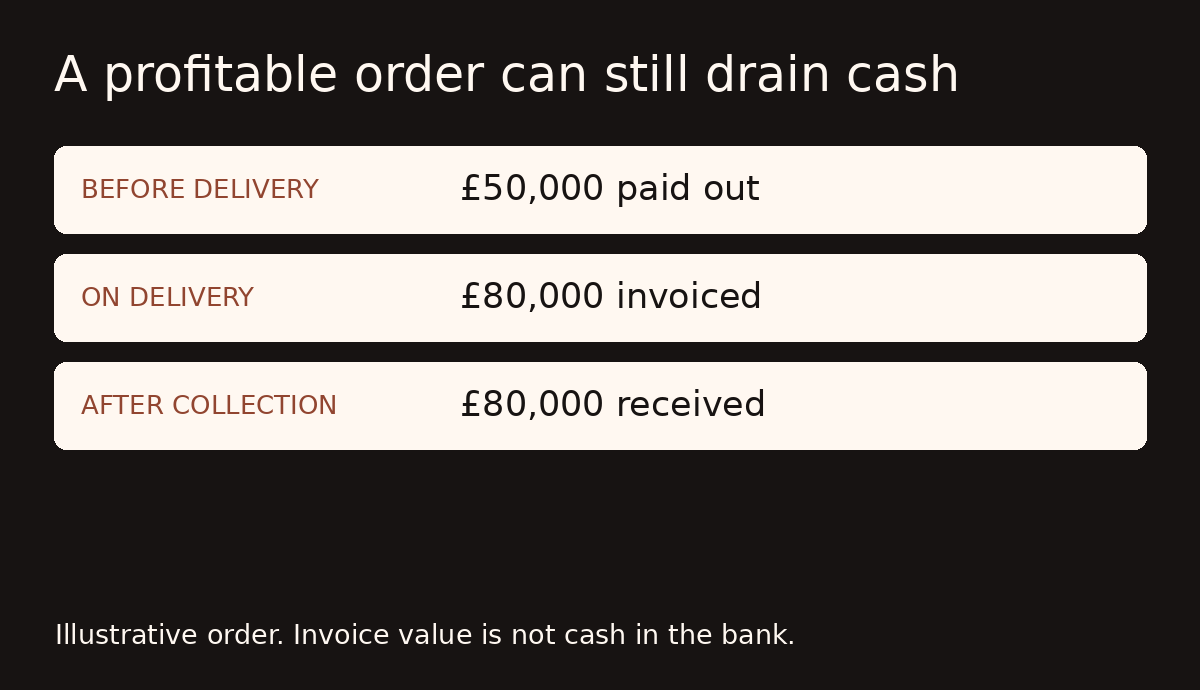
Imagine a manufacturer takes an order worth £80,000. It pays £50,000 for the material and labour before the goods leave. It invoices on delivery and the customer pays later. On those simplified figures, the order earns £30,000 before other costs. In the weeks between paying for the work and collecting the invoice, the manufacturer still has to find the £50,000. If several orders follow the same pattern, the funding needed can rise with sales.
Now imagine the customer pays two weeks later than expected. The margin on the order may look the same. The money available for the next payment run looks different. If the business has already committed to the next batch of material, someone has to decide what can wait or what funding is available. By the time that conversation becomes urgent, several of the choices that would have helped may already have been made.
This is why I would ask to see when cash is expected to move alongside the profit figure. The British Business Bank’s guide to cash flow forecasting explains how to estimate incoming and outgoing cash over a period. ICAEW’s guidance on forecasts and inventory is useful when stock and commitments need a closer look. In a board meeting, I’d start with the largest assumptions. Which receipts matter most this month? What has the customer told us about timing? Which payments are due before those receipts?
Look at what it took to make the month look good
Suppose an operations director keeps deliveries on time by shifting people between jobs every afternoon. The customer sees the order arrive. The sales director sees the revenue. The operations director knows that the person who planned tomorrow’s work has already had to rewrite the schedule twice. All three are describing something that happened, but only one is seeing how much effort went into keeping the promise.
There’s nothing wrong with using initiative to get a job out. Trouble starts when the business plans next month as if the rescue were part of its ordinary capacity. If the same two people keep covering gaps, ask what they are postponing to do it. It may be training a colleague, improving a process or visiting a customer whose account is becoming less secure. You can keep the present result respectable for quite a while by borrowing time from work that matters later.
Take a few jobs that went through on time and ask the people who did the work what changed after the order was taken. Were other jobs moved? Did a director negotiate an exception? Was extra work charged to the customer or absorbed by the team? If the answers are unusual, they may simply show good judgement under pressure. If they come up on the same kind of job every week, use them when you price and plan the next one. I explore the way those pressures compound in Why Growth Adds Pressure Faster Than Clarity.
Find out who has quietly become indispensable
A founder often tells me the team runs the business. Then we look at the diary. A sales manager waits for a price to be approved. The customer whose renewal matters most wants to talk to the founder. Operations can adapt a plan, but if doing so affects another department, everyone wants the founder to make the final call. Each request is understandable. Together, they tell you what the organisation has yet to learn to do without that person.
The same dependency can sit anywhere. A service manager might be the only person who remembers why an important account gets special treatment. A finance lead may be able to reconcile a report because they know which entries always need adjusting. You can learn a lot by asking a colleague to take over one regular decision or task while the expert is available to help. Where do they hesitate? What information is missing? What can they do themselves, and what do they still need permission to do?
Give them access to the information and agree what they can decide. Then let them deal with a few comparable cases. If they need to come back to you each time, look at what they are asking for. Sometimes a boundary needs changing. Sometimes their question is reasonable because the case really is exceptional. The point of observing it is to discover the difference while you still have time to help them learn.
Watch the commitments that precede the accounts
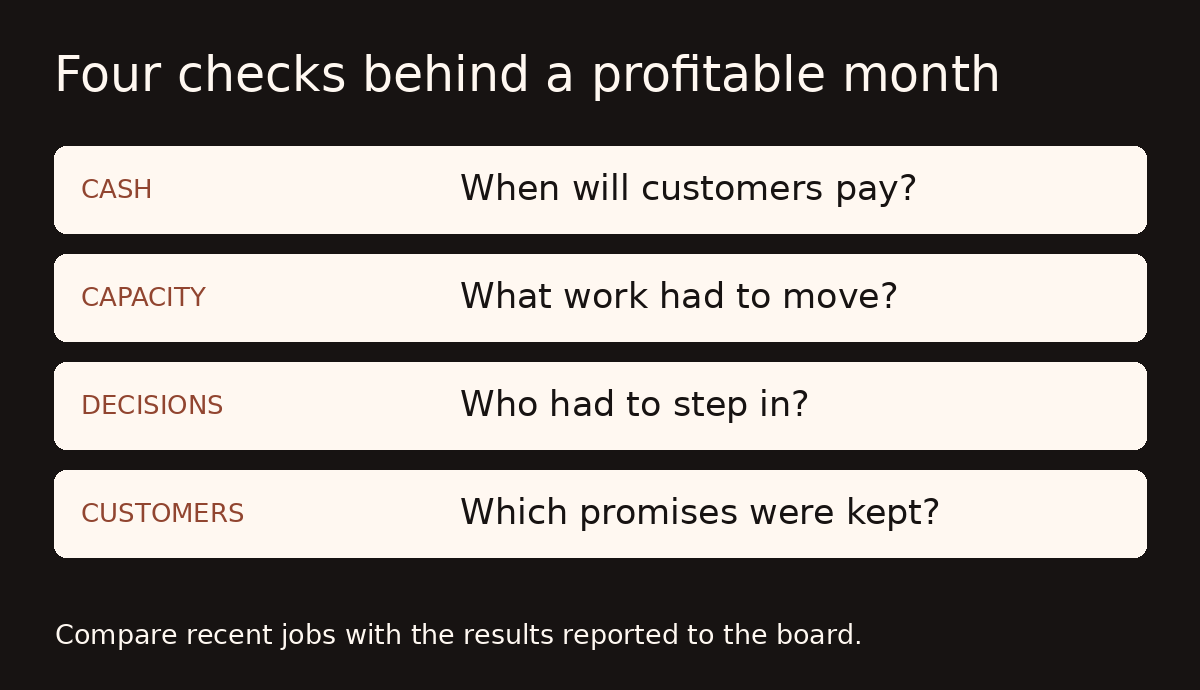
I’d look at four things together: when money is expected, which work has to move when new orders come in, which decisions are being taken upstairs, and which customer promises the team is actually keeping. The value is in asking whether the same jobs show up in more than one conversation. If a large order repeatedly needs senior approval, uses more time than expected and pays later than planned, you have something specific to examine.
Choose a handful of orders and compare them with the figures in the management report. Ask someone from sales, delivery and finance to account for the same job. Sales may say the terms were agreed early. Delivery may tell you the specification changed after that meeting. Finance may be waiting for signoff before it can issue an invoice. Put those accounts together and you can see where an apparently healthy order occupied people for longer and tied up cash for longer than anyone expected.
If the same problem recurs, agree who can change the process where it begins. For example, the person approving a change to a specification might need to confirm who is paying for it and whether the existing delivery date still stands. If they can’t see which other commitments are affected, give them that visibility. If they can see the effect but nobody will let them say no, agree who can. A new report will help you find the problem. Someone still needs to be able to act on what it shows.
Ask what would change your mind
Decide how much evidence you need before you change the way the business works. One late payment from a usually dependable customer may have a simple explanation. If several customers are taking longer to pay, look at whether they’ve been given different terms, whether invoices are being disputed or whether the time between delivery and invoicing has grown. Each calls for a different response. The same principle applies to operations. One difficult job may have needed everyone’s help. A series of different jobs needing the same person’s help tells you something about how the organisation works.
I would ask the board to decide which of those findings warrants action now. If the issue is timing, agree who will update the forecast, what assumptions they will check and when you need to see the position again. If the issue is recurring rework, choose the point at which you can prevent it from entering the system. Give someone the authority to test that change and a date to report back. Be clear about what they can decide themselves and when they need to raise an exception.
At the review, compare the new figures with the experience of the people doing the work. If there are fewer late deliveries but everyone is working longer, find out what changed. If cash collection has improved because a large customer paid early, see what happens in an ordinary week. An improvement is more useful when you can explain how it was achieved and what it will take to repeat it. That’s the kind of evidence I’d want before using the latest results as a basis for taking on more work.
Use the next month to test one assumption
Pick one belief that gives you confidence in the current results. Perhaps you believe your biggest accounts always pay within the terms agreed, or that anyone in the commercial team can renew them. Look back at several comparable cases. What happened, when did it happen and who had to become involved? It’s easier to discuss a particular invoice or renewal than argue about whether the business is generally well run.
Say the issue you find is that invoices are waiting for customer signoff. Try agreeing who obtains that signoff and how it will be recorded before new work begins. At the end of the month, compare the time from delivery to invoice with the time it took before. Check whether the change made the customer’s part of the process harder. If it did, ask where the extra work landed and whether there’s a better way to get the same evidence.
Then ask what would happen if the person who usually rescues the process were away. Can someone else tell what has been agreed and what to do next? Could finance invoice without making several calls? That question is as useful to an owner who wants a quieter week as it is to someone thinking about succession. I look at what counts as evidence of a handover in Exit Readiness: Can the Business Run Without You?.
A good result gives you room to look at these things before they become urgent. Use the next board meeting to follow one profitable job from the original promise all the way to the money arriving. Ask what had to happen away from the customer’s view, and what would happen if nobody were there to do it next time. You’ll come away knowing more about the strength of the business than you can get from the profit figure alone.
Questions and answers
Can a business make a profit and still run out of cash?
Yes. The business can record a sale before it receives payment, while wages, suppliers and other obligations fall due in the meantime. A forecast based on payment dates can show where the gap is likely to occur.
What operational warning signs should a board look for?
Watch for repeat delivery rescues, routine approvals going to senior leaders and delays between completing work and invoicing. Trace actual jobs to see whether these signs have a common cause.
How can I test whether the business depends on one person?
Choose an important recurring task or decision and ask someone else to handle a few comparable cases with agreed authority. Observe where they need the original person’s knowledge, access or permission.
What should I review alongside profit?
Review expected cash receipts and payments, the work required to keep commitments, where decisions sit and the promises customers actually experience. Use examples to connect the numbers to how the business produced them.
Further reading
In The Strategic Architect, I explore what happens when the organisation relies on capable leaders to carry work it could learn to handle. Find The Strategic Architect on Amazon.